Saffron in Persian cooking: how the world's most expensive spice is used
In Sweden saffron means Lucia buns. In Iran it is everyday food. How Iranians grind, bloom and use saffron, and why it is never sprinkled dry over the food.
In this article
In Persian cooking saffron is ground, steeped in warm water and added at the end, so that a very small amount colours and scents a whole pot of rice. In Sweden most people connect saffron with December: Lucia buns, saffron cake and perhaps a bouillabaisse. In Iran saffron is everyday. It turns the rice golden, scents the stews and flavours the desserts.
Saffron at a glance
- What it is: the dried stigmas of the saffron crocus
- Origin: most of the world's saffron comes from Iran
- The Persian method: grind the threads, steep in warm water, use the liquid
- Used in: rice, stews, chicken, desserts and tea
- Tip: a little goes a long way; too much turns bitter
Why saffron is so expensive
Every crocus flower has three stigmas, and they are picked by hand. It takes tens of thousands of flowers to make a few grams. The harvest lasts a few weeks in the autumn, early in the morning before the flowers open fully. That is why saffron costs more per gram than almost anything else in the kitchen.
How Iranians use saffron
The Persian method is simple and makes a small amount go far:
- Grind the threads to a powder in a mortar, with a pinch of sugar or an ice cube to help.
- Pour on warm water, a few tablespoons, not boiling.
- Let it steep for at least ten minutes, longer if you can. The liquid turns deep orange and smells strongly.
- Use the liquid at the end of cooking, so the scent does not boil away.
Dry threads sprinkled straight into the food rarely give full colour or taste. This is why Iranian saffron dishes often taste more of saffron than you would expect from the small amount used.
Where saffron appears in Persian food
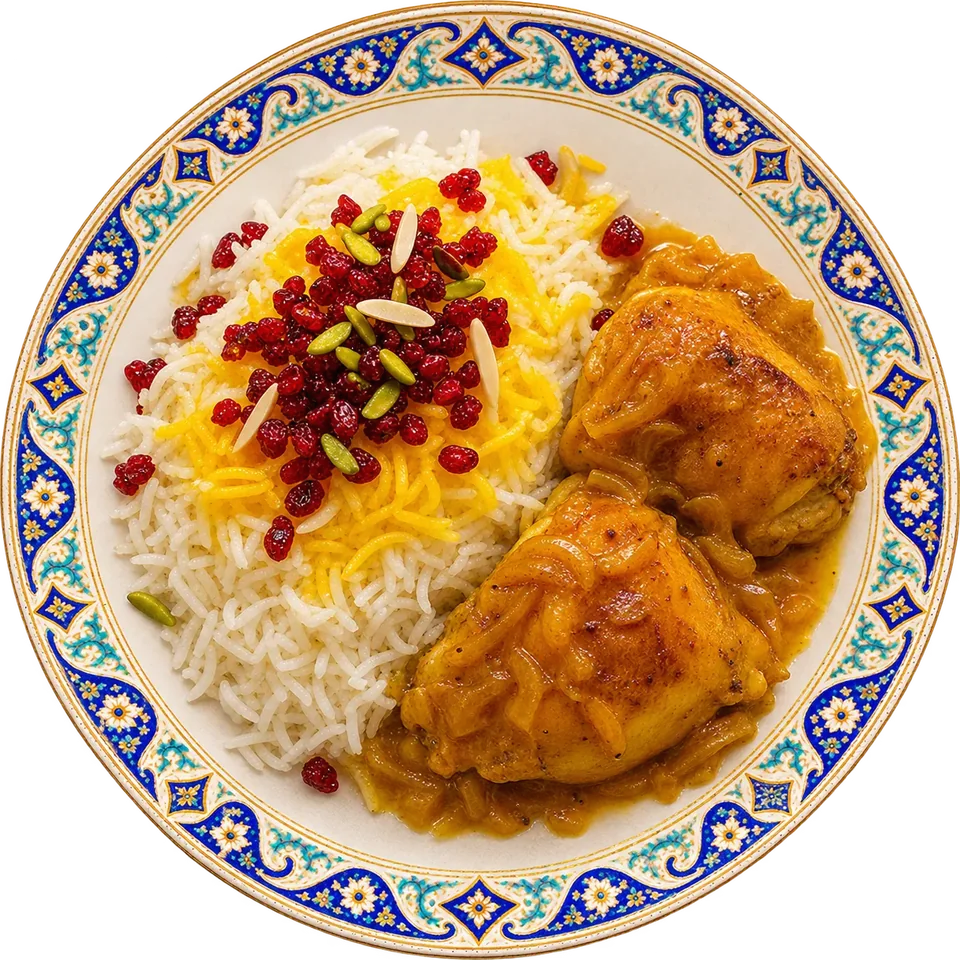
- Rice. Part of the finished rice is mixed with saffron liquid and laid over the white, so the plate has both white and golden rice. That is how zereshk polo ba morgh gets its colour.
- Tahdig. Saffron at the bottom of the pot gives tahdig its golden crust.
- Stews. A splash towards the end in, for example, fesenjan or chicken stews.
- Desserts. Sholeh zard, a saffron rice pudding, and saffron ice cream with rose water and pistachio.
How to recognise real saffron
Buy threads rather than powder, because powder is easier to dilute. Real threads are deep red, often slightly trumpet-shaped at one end, and they colour water yellow slowly, not red in a second. Iranian shops in Stockholm sell good saffron, often at a lower price than ordinary supermarkets.
Saffron at Douri
Douri cooks with real Iranian saffron, ground and bloomed the Persian way, in the rice and in the stews. More about the dishes is in the guide to Persian food.
Frequently asked questions
How do you use saffron threads?
Grind the threads with a pinch of sugar in a mortar, pour over a few tablespoons of warm water and let it steep for at least ten minutes before you use the liquid.
How can you tell real saffron?
Real saffron threads are deep red, slightly trumpet-shaped at one end, and colour water yellow slowly. If the water turns red at once it may be fake.
Where does most of the world's saffron come from?
From Iran, which grows by far the largest share of the world's saffron.
Why is saffron so expensive?
Each crocus flower has only three stigmas and they are picked by hand. It takes tens of thousands of flowers to make a few grams.